From observation to intervention
An illustrative research article about turning an observed pattern into a precise question about change.
A pattern is a starting point
Illustrative article and layout sample. This fictional scenario demonstrates the structure of a research article. It contains no measured findings, Abel model outputs, or recommendation for a real operation.
Imagine a small delivery service reviewing its weekly records. On weeks with more incoming orders, more deliveries arrive late. The team wants to understand the relationship, but its practical question is narrower: would adding an evening shift reduce late deliveries?
Those two sentences describe different tasks. The first concerns a pattern in existing records. The second concerns a deliberate change to how the service operates. A useful research note should make that transition visible, so a reader can see what has been observed and what still needs to be established.
Make the proposed change concrete
“Increase capacity” leaves too much unspecified for this example. We will instead ask about adding one evening shift at one depot for four weeks, while keeping the service area and promised delivery windows unchanged.
The outcome also needs a definition. Here, a late delivery means an order delivered after its promised window; the summary is the share of eligible orders that are late. This definition separates a change in the number of late orders from a change in the proportion of orders delivered late.
Give assumptions a place on the page
For the fictional service, suppose a demand surge can increase both order volume and pressure on the depot. Suppose staffing, route length, and the mix of orders can also affect the work required. These are proposed relationships for the scenario, not conclusions recovered from data.
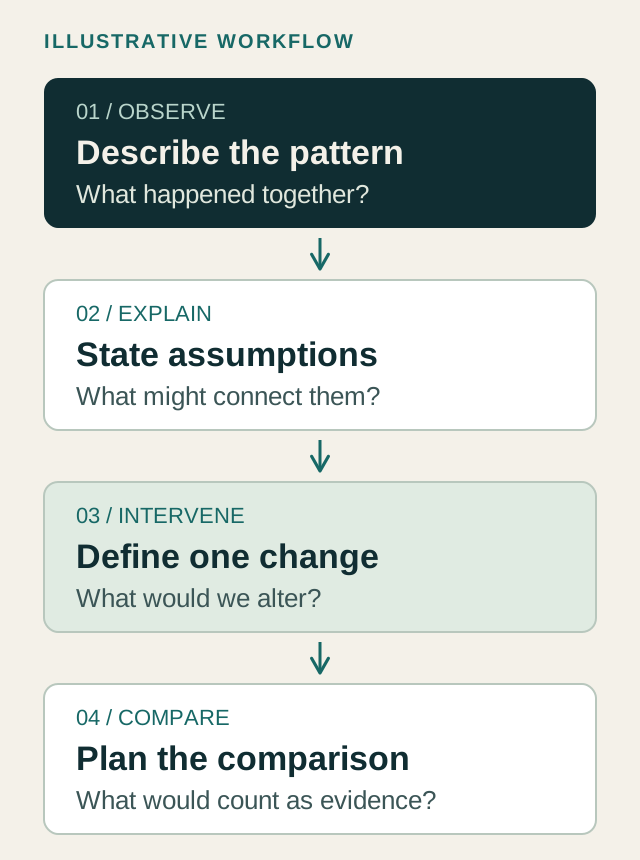
The workflow below keeps that distinction in view. Each step creates a different kind of research artifact: a description, an assumption record, an intervention definition, or a comparison plan.
Separate records from interpretations
The table gives examples of what a research notebook might contain. It reports no experimental results or benchmark scores.
| Notebook entry | Role in this scenario | Question still open |
|---|---|---|
| Weekly order volume | An observation to describe | Is the order mix comparable? |
| Depot workload | A proposed explanation | How should workload be measured? |
| An evening shift | A candidate intervention | What tasks would the shift cover? |
| Share of late deliveries | A defined outcome | Which orders belong in the comparison? |
Writing these entries separately makes disagreements easier to locate. A reader may accept the description of order volume while questioning the workload measure or the proposed comparison.
Record the question before estimating an answer
A compact, inspectable record can help keep the analysis tied to its original scope. The code below only prints the fictional study question. Its output is static, and it estimates no effect.
question = {
    "change": "Add one evening shift",
    "outcome": "Share of late deliveries",
    "window": "Four weeks at one depot",
}

for field, value in question.items():
    print(f"{field}: {value}")
change: Add one evening shift
outcome: Share of late deliveries
window: Four weeks at one depot
The next artifact would be a comparison plan: which deliveries are eligible, when staffing changes, what else changes during the same period, and how uncertainty will be reported. This sample stops before selecting or applying an estimation method.
Keep the limits beside the conclusion
An explicit intervention question is a clearer research starting point. It is not, by itself, evidence that the intervention will work.
What this example leaves unresolved
The scenario does not include a dataset, a validated causal graph, a staffing experiment, or a cost model. It does not establish whether order volume causes delays or whether an additional shift would help.
Even within the fictional setting, the proposed comparison would need scrutiny. Staffing might change in response to expected demand; drivers might serve several depots; the four-week window might omit effects that appear later. These possibilities are questions to investigate, not findings of this article.
Leave with a better specified question
The result of this exercise is a research question with visible boundaries: one defined change, one outcome, one location, and one time window. The observed pattern motivates that question; the assumptions and comparison plan determine what evidence would be needed to answer it.
For a real study, the next step would be to review those choices with the people who understand the operation and the available records. For this illustrative article, the stopping point is deliberate: the question is specified, and the answer remains open.